About Montessori Violin
Where Montessori education and violin pedagogy meet
Montessori Violin grew from the recognition that learning an instrument can be approached in much the same way Montessori children encounter other complex work: through careful observation, purposeful preparation, precise presentation, repetition, and increasing independence. The curriculum brings those principles into violin study through a developmental sequence for children ages 3–12, with distinct pathways for private study, Montessori schools, and professionally prepared instructors.
Developed From Two Lifelong Practices
Montessori education and musicianship brought into one developmental framework
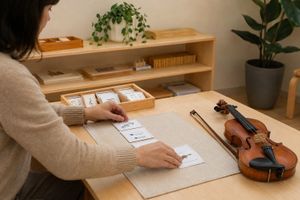
Montessori Violin was developed by Jennifer DeHaan, an AMI-certified Montessori guide with an M.Ed. in Montessori Education from Loyola University Maryland and decades of experience as a violinist. The curriculum grew from bringing these two bodies of experience together: the developmental precision of Montessori education and the practical realities of learning and teaching a string instrument. Rather than placing conventional violin lessons inside a Montessori classroom, the work asks a different question: what might violin education look like if it were developed from Montessori principles from the beginning?
A Harmonic Synthesis
Not violin added to Montessori, but violin education reconsidered through Montessori principles
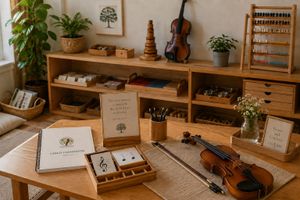
Montessori Violin is built around the child’s development rather than a fixed sequence of weekly lessons. The prepared environment, observation of readiness, careful presentation, purposeful materials, repetition, control of error, and gradual withdrawal of adult assistance all shape how musical work is introduced. As competence develops, responsibility grows with it. The goal is not simply to teach children to play the violin, but to create conditions in which musical understanding, technique, concentration, independence, and eventually shared musicianship can develop together.